
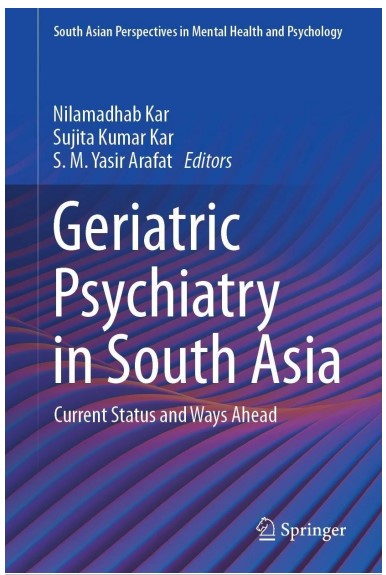
 The book “Geriatric Psychiatry in South Asia: Current Status and Ways Ahead,” published by Springer Nature,1 takes the initiative of looking at the growing old age-related mental health concerns in the South Asian countries. This will be useful in the context that the population of older adults in these countries is growing exponentially; and understanding their mental health concerns and management approaches will help the clinicians and authorities to prepare well for developing the services.
This book will increase the awareness about the growing needs of old age care, especially in these regions where there are scant services, resources, and a smaller number of trained professionals.2 Another worrying concern is that these countries experience economic migration, so that the younger generation is moving away to different places or countries for work, leaving older adults behind. So the number of older people living alone and in old-age homes is increasing. Stress, isolation, anxiety, and depression are on the rise. Old age mental health concerns are going to rise and this book would be timely to improve the knowledgebase in the area.
There is inadequate research about the mental health burden, psychosocial concerns, and any interventions. There are many other worrying concerns, such as financial struggles for health-related expenses, lack of caregivers, and elder abuse. This book highlights the support, policies, programmes, and laws available in these countries and what is needed.
The book covers various areas of the current status of old age psychiatry in South Asian countries in its 12 chapters.3–14 There are country-specific chapters that highlight the specific issues relevant to the countries.3,6,7,10,13,14 All these countries are developing economies at various levels, and the range of services varies considerably. It is insightful to see how the services are at the moment, the future needs in these countries and how these can be managed.
There are chapters covering specific topics such as disease burden and services gap,9 social determinants and cultural aspects,8 old age related public mental health,12 prevention,4 substance use,11 and existing policies, programs and laws,5 in these countries. While the book highlights the current state of affairs in old age mental health care, it also emphasizes the importance of preventing psychiatric illnesses through various strategies. The chapters give ideas about what can be done at clinic, community, state, and country level, and how regional cooperation among South Asian countries would be helpful.
This book covers relevant areas and is highly comprehensive. It will be helpful not only to mental health professionals in old age psychiatry, but also to professionals working with older adults, geriatric medicine, nurses, social workers, occupational therapists, counsellors and psychologists, planners and policy makers, and the health authorities looking after and developing services for the older adults. This will be a useful resource for non-governmental organisations working in the field of old age care, the medical centres, and training institutes.
- Kar SK, Arafat SMY. Geriatric Psychiatry in Other SouthAsian Countries: Afghanistan, Bhutan, the Maldives. In Geriatric Psychiatry in South Asia: Current Status and Ways Ahead (eds N Kar, SK Kar, SMY Arafat ): 113–23. Springer Nature, 2025.
References
- Kar N, Kar SK, Arafat SMY, editors. Geriatric Psychiatry in South Asia: Current Status and Ways Ahead. Springer Nature, 2025 doi:10.1007/978-981-96-7469-5.
- Matthews NR, Porter GJ, Varghese M, Sapkota N, KhanMM, Lukose A, et al. Health and socioeconomic resource provision for older people in South Asian countries: Bangladesh, India, Nepal, Pakistan and Sri Lanka evidence from NEESAMA. Global Health Action 2023; 16: 2110198.
- Arafat SMY, Mazumder AH. Geriatric Psychiatry in Bangladesh: Current Status and Ways Ahead. In Geriatric Psychiatry in South Asia: Current Status and Ways Ahead (eds N Kar, SK Kar,SMY Arafat ): 19–36. Springer Nature,
- BhattacharyyaS, Cadwaladr B, Benbow SM, Soundararajan
- Preventing Mental Illnesses in Old Age: Strategies and Evidence. In Geriatric Psychiatry in South Asia: Current Status and Ways Ahead (eds N Kar, SK Kar,SMY Arafat ): 207–34. Springer Nature, 2025.
- Kar N, Bhattacharya S, Kar S. Policies, Programs, and Action Plans in Geriatric Mental Health in South Asia. In Geriatric Psychiatry in South Asia: Current Status and Ways Ahead (eds N Kar, SK Kar,SMY Arafat ): 235–64. Springer Nature,
- Khan O, Sheikh S, Farooq S. Geriatric Psychiatry in Pakistan. In Geriatric Psychiatry in South Asia: Current Status and Ways Ahead (eds N Kar, SK Kar,SMY Arafat ): 67–87. Springer Nature, 2025.
- Khurana H, Sethi S. Social Determinants and CulturalAspects of Geriatric Mental Health in South Asia. In Geriatric Psychiatry in South Asia: Current Status and Ways Ahead (eds N Kar, SK Kar, SMY Arafat ): 147–83. Springer Nature, 2025.
- Santhanakrishnan M, Kantipudi SJ, Loo JL. Disease Burden and Services Gap in Geriatric Psychiatry in South Asia: An Overview. In Geriatric Psychiatry in South Asia: Current Statusand Ways Ahead (eds N Kar, SK Kar, SMY Arafat ): 1–
- SpringerNature, 2025.
- Sharma P, Rijal R, Dhungel O. Geriatric Psychiatry in Nepal. In Geriatric Psychiatry in South Asia: Current Status and Ways Ahead (eds N Kar, SK Kar,SMY Arafat ): 53–66. Springer Nature, 2025.
- Singh A, Shukla S, Parmar A. Substance Use in Old Age in South Asia. In Geriatric Psychiatry in South Asia: Current Status and Ways Ahead (eds N Kar, SK Kar,SMY Arafat ): 125–45. Springer Nature, 2025.
- Tewari A, Agrawal A, Vishwakarma A. Public Mental Health Aspects of Geriatric Psychiatry in South Asia. In Geriatric Psychiatry in South Asia: Current Status and Ways Ahead (eds N Kar,SK Kar, SMY Arafat ): 185–205. Springer Nature,
- Vidya KL, Kumar P. Geriatric Psychiatry in India. In Geriatric Psychiatry in South Asia: Current Status and Ways Ahead (eds N Kar, SK Kar,SMY Arafat ): 37–51. Springer Nature,
- Wickramasinghe A, Gunathilake M. Geriatric Psychiatry inSri Lanka. In Geriatric Psychiatry in South Asia: Current Status and Ways Ahead (eds N Kar, SK Kar, SMY Arafat ): 89–111. Springer Nature, 2025.